Across India's spinning belts — from Coimbatore and Tirupur in Tamil Nadu to Surat's synthetic clusters and Ludhiana's woolen units — mill managers are asking the same question in 2026: Is it time to replace the ageing winders on the floor?
The answer, for a growing number of production and purchase managers, is yes. Rising labour costs, increasing export quality demands, and the pressure to reduce per-kilogram processing costs are pushing Indian mills toward modern high-speed cone winding machines — not because the old machines have stopped working, but because the economics of running them no longer make sense.
The Productivity Gap Is Widening
Older winding machines in Indian mills typically operate at speeds well below 400 MPM. High-speed cone winders now run at 500, 600, or 700 metres per minute — meaning the same number of spindles can wind significantly more yarn per shift without adding headcount.
For a 60-spindle section running two shifts, moving from 350 MPM to 600 MPM does not simply translate to a proportional output increase. The compound effect on package changeover time, downtime per break, and shift utilisation means the actual throughput gain in practice often exceeds the raw speed difference.
Mills running yarn dyeing and spinning operations have found that upgrading winding capacity is frequently the single most cost-effective modernisation step — more impactful than adding capacity elsewhere in the process chain.
Better Package Quality, Fewer Rework Cycles
Package quality in winding is not just a cosmetic concern. Unevenly wound packages — those with ribbon formation, loose or tight layering, or inconsistent density — cause real downstream costs: uneven dye penetration, fabric defects in weaving, and thread breaks on the loom. Every rework cycle in the dyeing department traces back, in part, to package preparation.
Modern high-speed cone winders address this with two key systems:
- Electro-mechanical ribbon breaker (anti-patterning system): Prevents yarn from laying in repeating patterns on the package surface. This results in uniform density across the cross-section — critical for consistent dye penetration and long-term package stability.
- Automatic mechanical stop motion: Detects yarn breaks instantly and stops the spindle before the defect propagates. This protects package integrity and reduces waste per break event.
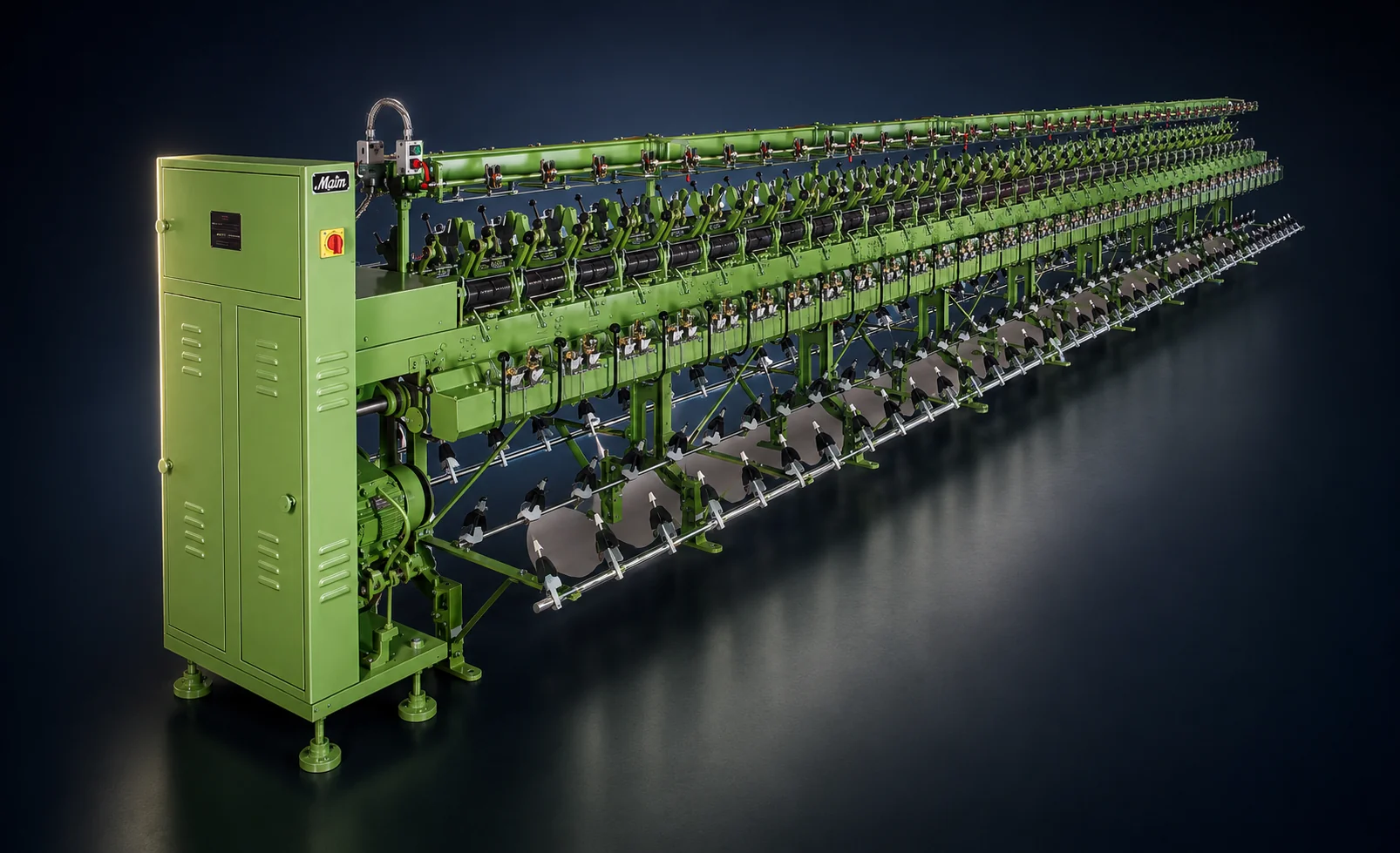
The RJK High Speed Cone Winding Machine includes both systems as standard. The result is packages with better structure for hard and soft cone dyeing, reduced rework rates in the dye house, and improved consistency across batches.
Lower Maintenance, Longer Machine Life
One of the most frequently underestimated costs in winding operations is maintenance — specifically, the cumulative cost of unplanned stoppages, bearing replacements, and lubrication-related wear over a machine's service life.
Older winding machines often rely on manual greasing schedules that are inconsistently followed, leading to accelerated wear on spindle bearings and drive components. High-speed machines built for modern production environments solve this with oil bath and circulating lubrication systems.
The RJK cone winder uses a dual lubrication approach: an oil bath for base components and a circulating system for consistent spindle lubrication. Combined with double-sealed ball bearings and dynamically balanced aluminium traverse drums, the result is a machine that runs longer between service intervals and requires fewer unplanned interventions.
For mills operating two or three shifts, this translates directly to more productive hours per year and a lower cost-per-spindle over the machine's operational life. Explore our after-sales support and service network to understand what this looks like in practice.
Energy Efficiency at Scale
Energy consumption in winding is often overlooked in favour of discussions about weaving, spinning, or dyeing. But for a 100–160 spindle winding section running two shifts, electrical costs are meaningful — and older machines with poorly balanced drives, oversized motors relative to the load, and no speed optimisation consume more per kilogram wound than modern equivalents.
The RJK high-speed cone winder runs at 10.5 HP (or 11.5 HP with optional blower) across configurations up to 160 spindles. The balanced aluminium drums and efficient drive train reduce vibration-related energy losses, and the ability to select the appropriate speed variant (500, 600, or 700 MPM) for the specific yarn type means mills are not over-driving machinery relative to the application.
See the RJK Cone Winder Specifications
Compare spindle counts, speeds, package sizes, and machine dimensions for your production setup.
View Full Specifications →The Case for an Indian-Made Alternative
The dominant argument against European winding machines for mid-size Indian mills has always been cost — imports from brands like SSM (Switzerland) or Murata (Japan) typically carry price tags 3 to 6 times higher than comparable Indian-made machines. But the conversation in 2026 has shifted from pure price to total cost of ownership.
When mills factor in spare parts lead times, service response, and the availability of trained engineers, Indian-manufactured machines from established producers have a decisive advantage. RJK spare parts are available overnight across India. A service engineer can be on-site within days, not weeks.
RJK Group has been manufacturing winding machines in Ahmedabad since 1945. The high-speed cone winder has been in continuous production since the 1970s — not a recently launched product, but a machine with over five decades of field refinement, with more than 300,000 spindles installed across India and in 10+ countries including Bangladesh, Sri Lanka, Indonesia, Kenya, and Nigeria.
For mills looking to modernise without paying import premiums or waiting on overseas service, the RJK High Speed Cone Winding Machine offers a direct path to the productivity and quality gains that high-speed winding delivers — at 40–60% of the cost of European alternatives. See the full RJK product range for the complete winding lineup.
Frequently Asked Questions
What is the winding speed of a high-speed cone winding machine?
Modern high-speed cone winding machines operate at 500, 600, or 700 metres per minute (MPM) depending on yarn type and package requirements. The RJK High Speed Cone Winding Machine offers all three speed options in a single configurable machine, allowing mills to match speed to the yarn being processed.
How does an anti-patterning system improve package quality?
An electro-mechanical ribbon breaker (the anti-patterning system) prevents yarn from laying in repeating parallel patterns during winding. Without it, ribbon formation creates hard bands in the package that restrict dye liquor flow and cause uneven colour uptake. With it, package density is uniform through the cross-section — which is the foundation of consistent dyeing results.
What is the advantage of an oil circulation lubrication system?
An oil circulation system delivers continuous, consistent lubrication to base components and spindles during operation. This reduces heat build-up, lowers bearing wear, and significantly extends service life compared to manual greasing schedules. For mills running two or three shifts, this difference in service intervals has a direct impact on productive hours per year.
Which yarn types can a high-speed cone winding machine handle?
High-speed cone winding machines can process cotton, synthetic (polyester, nylon), blended, and woolen yarns. The RJK cone winder handles all these yarn types across both hard and soft package applications — on paper or plastic cones, as well as parallel tubes for weft feeding.
Is an Indian-made cone winding machine as reliable as European imports?
For the application range covered by Indian mills — cone winding for dyeing, weft preparation, and general yarn processing — Indian-made machines from established manufacturers deliver comparable performance. RJK cone winders have been operating in mills across India and 10+ countries since the 1970s, with more than 300,000 spindles installed. The advantage over imports is not just price: it is the availability of spare parts overnight and the response time of local service engineers.
How many spindles are available on the RJK High Speed Cone Winding Machine?
The RJK High Speed Cone Winding Machine is available in configurations from 20 to 160 spindles, scalable in multiples of 20. This makes it suitable for small dyeing units upgrading their first section as well as large production facilities requiring high-capacity winding lines.