Across India's weaving clusters — Bhiwandi, Surat, Erode, Panipat, Ludhiana — and the knitting belts of Tirupur and Kolkata, the question of yarn preparation rarely gets the attention it deserves. Production managers focus on loom efficiency, knitting machine downtime, and fabric defect rates. But a significant proportion of those defects are determined not on the loom or the knitting frame — they are determined at the winding stage, before the yarn ever reaches the production floor.
For multi-ply yarn operations — whether running ring twisters, TFO machines, or doubling before weaving — the parallel ply winding stage is where yarn quality is made or lost. Uniform tension, correct ply assembly, and consistent package build at this step translate directly into better fabric uniformity, fewer thread breaks in production, and lower rework rates downstream.
What Parallel Ply Winding Actually Does
Before a multi-ply yarn can be twisted, the individual ends need to be assembled in parallel — wound together onto a single package with equal tension and equal length per end. This is the role of the doubler or parallel ply winder.
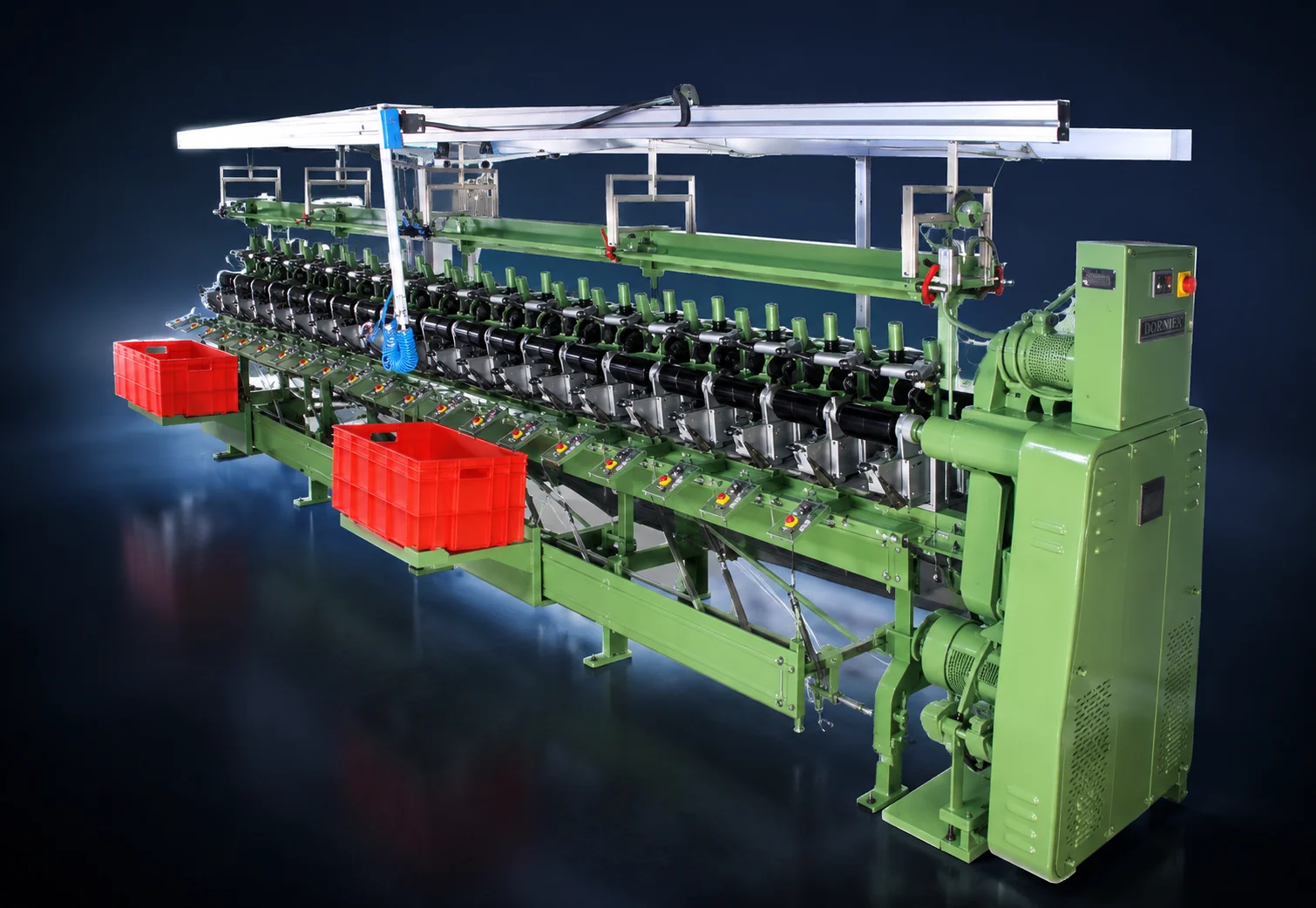
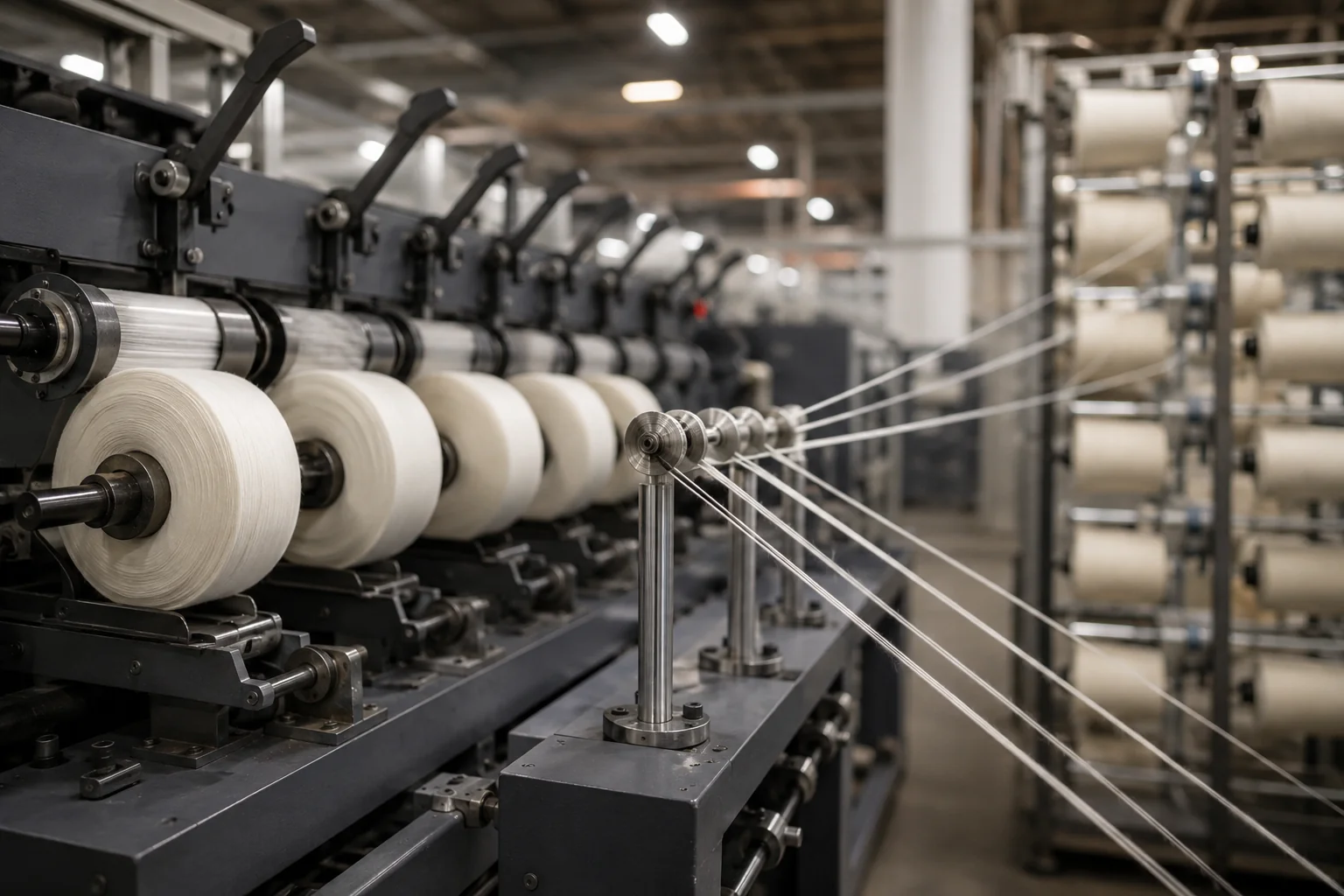
In a single pass, a parallel ply winder draws two, four, six, or eight individual yarn ends from supply packages on the creel and winds them together onto a parallel cheese or tube. Every spindle on the machine does this simultaneously. The assembled package is then fed into a ring twister or TFO to produce the final plied yarn.
The distinction between this process and simply twisting multiple ends together in a single step matters: assembly winding gives each end a dedicated tension control point before twisting begins. Without this step, tension variation between ends is compounded through the twist zone — and the resulting yarn carries that variation into every metre of fabric woven or knitted from it.
Why Uniform Tension Is the First Quality Control Point
In multi-ply yarn production, tension imbalance between ends is the root cause of a range of downstream quality problems that mills often misattribute to the twisting stage or to yarn count variation.
If one end in a 2-ply assembly enters the twist zone carrying more tension than the other, the tighter end contributes more to the yarn's twist structure than it should. The result is a non-uniform ply: uneven twist distribution, irregular diameter, and periodic variation in yarn strength. In the fabric:
- Woven fabric shows up as weft streaks or visible bar effects in the finished cloth
- Knitted fabric presents as ladder defects or uneven sheen across the panel
- Yarn strength variation from uneven ply structure increases warp and weft break rates on the loom and knitting machine
- Pilling and abrasion resistance are reduced in the final garment
A well-engineered parallel ply winder maintains consistent tension across all ends from supply package to delivery package. The RJK High Speed Doubler / Parallel Ply Winder achieves this through stainless steel guide pulleys with precision-finished surfaces, spindleless tube holders with double-sealed ball bearings, and — on the electronic variant — hard chrome plated balloon breakers that reduce tension variation at higher winding speeds.
How the Electronic Stop Motion System Reduces Downtime
In any winding operation, yarn breaks are unavoidable. The question is not whether breaks happen — it is how quickly the machine detects them and how much yarn is wasted and how much time is lost before the operator can re-piece.
Mechanical stop motion systems rely on physical drop-pins or drop-wires that fall when yarn tension is lost. They work reliably for straightforward operations, but there is an inherent mechanical lag — between the break occurring and the spindle stopping, several turns of yarn wrap around the package. In multi-ply operations especially, this creates tangled ends that take longer to clear.
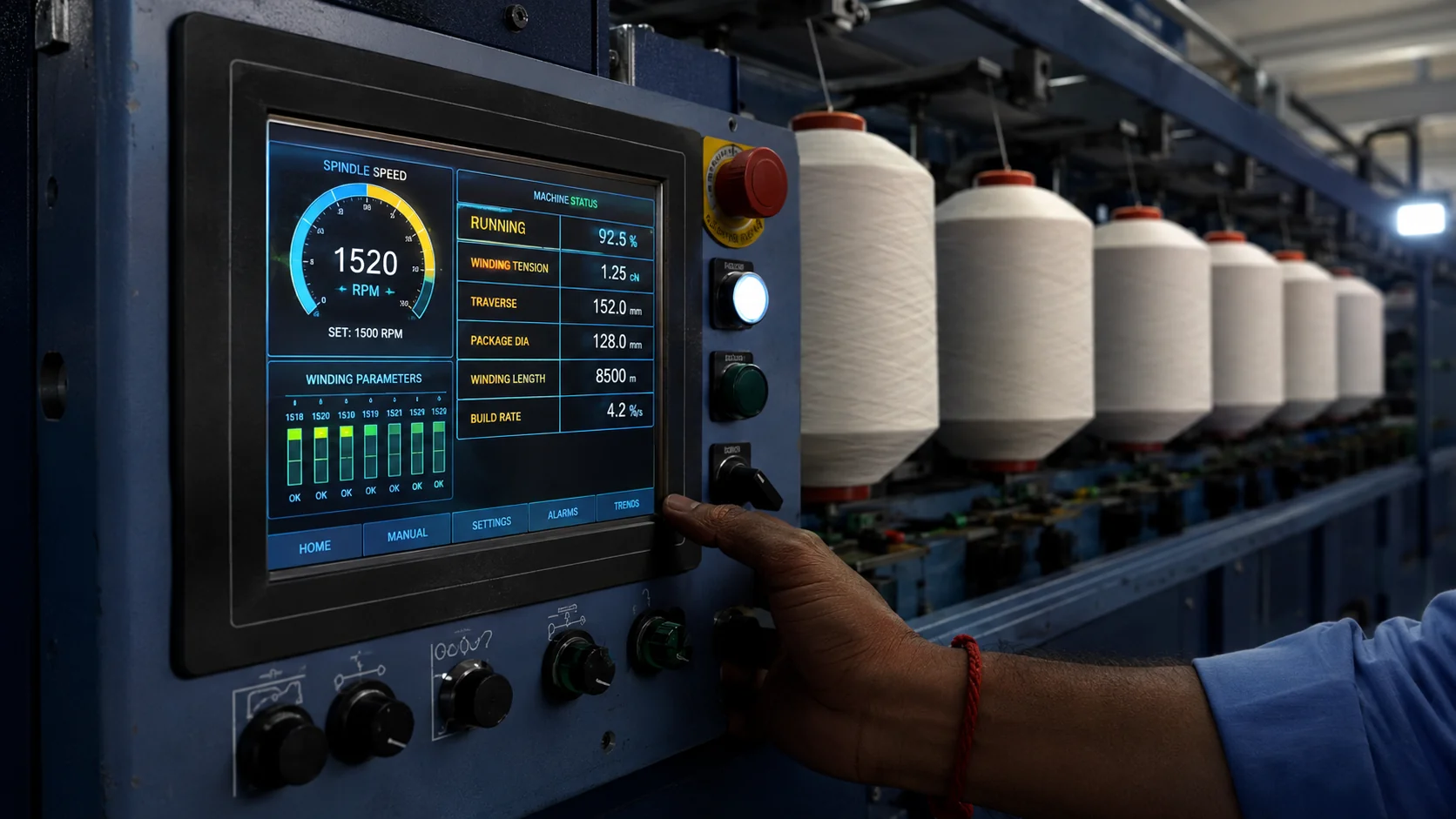
Electronic stop motion systems eliminate this lag. Detection is sensor-based — the moment the yarn path is disrupted, the spindle is signalled to stop. The RJK Electronic Stop Motion variant includes:
- Instantaneous tube-holder lifting: On break detection, the tube holder lifts immediately — taking the package away from the drum before the broken end can wrap around it. This is the key step that separates fast, clean re-piecing from a tangled package that must be discarded.
- Silver-tipped enclosed contacts: The RJK electronic system uses enclosed silver-tipped contacts rather than open magnetic coils. This prevents the carbon build-up and coil burning that causes false trips and sensor failure in open-contact designs — a common maintenance headache in mills running synthetic yarns that generate static.
- Split-end preventer: A dedicated feature for high-speed multi-ply winding — prevents split ends from wrapping around the package during high-count doubling, which is a particular failure mode when winding fine polyester or acrylic counts at speed.
Across a 100-spindle section running two eight-hour shifts, the difference in recovery time per break event between a mechanical and electronic system — even a few seconds per event — compounds into meaningful productive capacity over a week. For mills running three shifts on TFO prep or weaving weft preparation, the economics of this difference are significant.
See the RJK Doubler / Ply Winder Specifications
Compare Mechanical and Electronic Stop Motion variants — spindle counts, ply capability, count range, and dimensions.
View Full Specifications →Processing Cotton, Polyester, Acrylic, and Blended Yarns
India's weaving and knitting sectors do not work with a single yarn type. A mill in Tirupur processes cotton and cotton-polyester blends for knitwear. A Surat synthetic unit runs polyester filament and textured yarns. Ludhiana woolen mills double acrylic counts for blanket and shawl production. A Bhiwandi power loom cluster needs consistent weft packages across cotton, viscose, and blended counts.
Each yarn type has different tension characteristics, different static behaviour, and different requirements at the winding stage:
- Cotton yarns (Ne 20s–60s) are relatively forgiving but shed fly that can accumulate in the winding zone and cause false stops. The fully enclosed swing plate design on the RJK mechanical variant is specifically aimed at keeping the winding zone clean in cotton-processing environments.
- Polyester and synthetic yarns generate static that causes ends to cling together and creates false signals in open-contact stop motion systems. The RJK electronic variant's enclosed silver-tipped contacts are designed to resist this. Hard anodised aluminium drums (available as an optional attachment) provide the smooth drum surface essential for synthetic yarn at high speed.
- Acrylic and blended yarns are more elastic than cotton and require consistent tension delivery to prevent elongation variation between ends. The spindleless tube holder bearing design maintains consistent package geometry even as the delivery package builds — important for elastic fibre behaviour.
- Coarse counts (Ne 1s–20s) for woolen and blanket production typically require the separate creel option for oversized supply packages. The electronic variant's separate creel accommodates feed packages up to 250mm diameter — enabling longer production runs without creel changes.
The RJK Doubler / Parallel Ply Winder handles the full count range from 1s Ne to 120s Ne across both variants — covering practically the entire yarn range used in Indian weaving and knitting production.
Reducing Yarn Wastage in Multi-Ply Operations
Yarn wastage in parallel winding comes from three sources: breakage waste (yarn wasted when a break occurs and the spindle overruns before stopping), end-of-package waste (mismatched package depletion across multiple creel positions), and rework waste (packages that need to be rewound due to poor package build or patterning defects).
Each of these has a mechanical solution:
- Breakage waste is minimised by fast stop motion response — electronic systems stop the spindle faster and lift the tube holder instantly, preventing the broken end from generating metres of unusable wrap.
- End-of-package waste is a function of creel management. Running all ends from packages of consistent size and build (which is a function of upstream winding quality) minimises the frequency of staggered depletion across creel positions.
- Rework waste from patterning is addressed by the electronic ribbon breaker, which operates 32 times per minute to prevent yarn from laying in repeating patterns on the parallel tube or cheese. Patterned packages in doubling produce uneven ply assemblies — the ribbon breaker is the prevention mechanism.
Cast aluminium slub catchers with hardened steel blades on both variants remove thick places before they wind into the delivery package — protecting the downstream twisting stage from count irregularities that would otherwise cause twist non-uniformity or spindle breaks on the TFO.
Supporting High-Speed Production for Weaving and Knitting Units
At 500 MPM, the RJK parallel ply winder runs fast enough to serve as a genuine production bottleneck eliminator in most mid-size mills. For a 60-spindle doubler section preparing weft packages for a power loom cluster, 500 MPM with near-instant break recovery means the winding section keeps pace with downstream consumption without becoming the constraint.
For TFO operators — where the doubling stage directly determines TFO feed quality and twist uniformity — consistent package build from the doubler translates to fewer TFO stoppages and more uniform twist in the final yarn. The relationship between doubler quality and TFO performance is direct: a poorly assembled parallel package is the first cause of twist variation on the twister.
For knitting mills processing fine counts (Ne 40s–80s cotton or polyester), the 20–160 spindle range means the machine can be configured to match the exact capacity of the knitting section — running a 40-spindle doubler for a smaller circular knitting unit, or scaling to 100–160 spindles for a larger flat-knitting or hosiery operation.
The Indian-Made Advantage for After-Sales Support
The parallel ply winding stage is a continuous production process — a doubler section that goes down for an unplanned repair affects every downstream operation that depends on it. Response time for service and the availability of spares are therefore not secondary considerations; they are part of the machine's effective uptime.
RJK Group has been manufacturing winding machinery in Ahmedabad since 1945. The doubler and parallel ply winder has been in continuous production since the 1970s, with more than 300,000 spindles installed across India and in 10+ countries. Spare parts are available overnight. Service engineers can be on-site within days.
For Indian mills weighing the choice between an imported European doubler and an Indian-manufactured equivalent, the total cost calculation — machine price, spare parts lead time, service response, and the cost of unplanned downtime — consistently favours the Indian-made option for this application. The RJK High Speed Doubler / Parallel Ply Winder delivers the performance characteristics weaving and knitting units require at 40–60% of the cost of comparable European alternatives.
Frequently Asked Questions
What is parallel ply winding and how is it different from regular winding?
Parallel ply winding (also called doubling or assembly winding) combines two or more yarn ends in parallel onto a single package before the twisting stage. Unlike regular cone winding, which winds a single end, a parallel ply winder assembles multiple ends simultaneously — ensuring they enter the TFO or ring twister with equal tension and consistent length, which directly determines the quality of the final plied yarn.
How does an electronic stop motion system reduce downtime in weaving mills?
An electronic stop motion system uses sensor-based yarn break detection to halt the spindle the instant a break occurs. Unlike mechanical systems with a reaction lag, electronic detection is near-instantaneous — preventing the broken end from wrapping into the package, reducing waste per break event, and making re-piecing faster for the operator. Across a 100–160 spindle section running two shifts, this difference compounds into measurably fewer productive hours lost to break-related stoppages.
Which yarn types can a doubler / parallel ply winder process?
A parallel ply winder handles cotton, polyester, acrylic, blended, and woolen yarns across a wide count range. The RJK High Speed Doubler / Parallel Ply Winder processes counts from 1s Ne to 120s Ne, covering fine cotton, coarse synthetic, and blended counts used across weaving, knitting, and TFO operations.
How many plies can a doubler winder assemble in a single pass?
The RJK doubler winder is available in two variants. The Mechanical Stop Motion variant supports up to 4-ply with creel arrangement. The Electronic Stop Motion variant supports up to 8-ply with a separate creel for oversized supply cones — suitable for high-count multi-ply doubling before ring twisting or TFO operations.
Why does uniform tension in parallel winding matter for fabric quality?
If individual ends enter the twist zone with unequal tension, one end carries more load than the others — creating a non-uniform ply structure with uneven twist distribution and irregular diameter. In woven fabric, this shows as weft streaks or bar effects; in knitted fabric, as ladder defects or uneven sheen. Consistent tension across all ends during parallel winding is the first control point that prevents these downstream quality problems.
What is the winding speed of the RJK Parallel Ply Winder?
The RJK High Speed Doubler / Parallel Ply Winder operates at up to 500 MPM in both Mechanical and Electronic Stop Motion variants, across configurations from 20 to 160 spindles in multiples of 20.