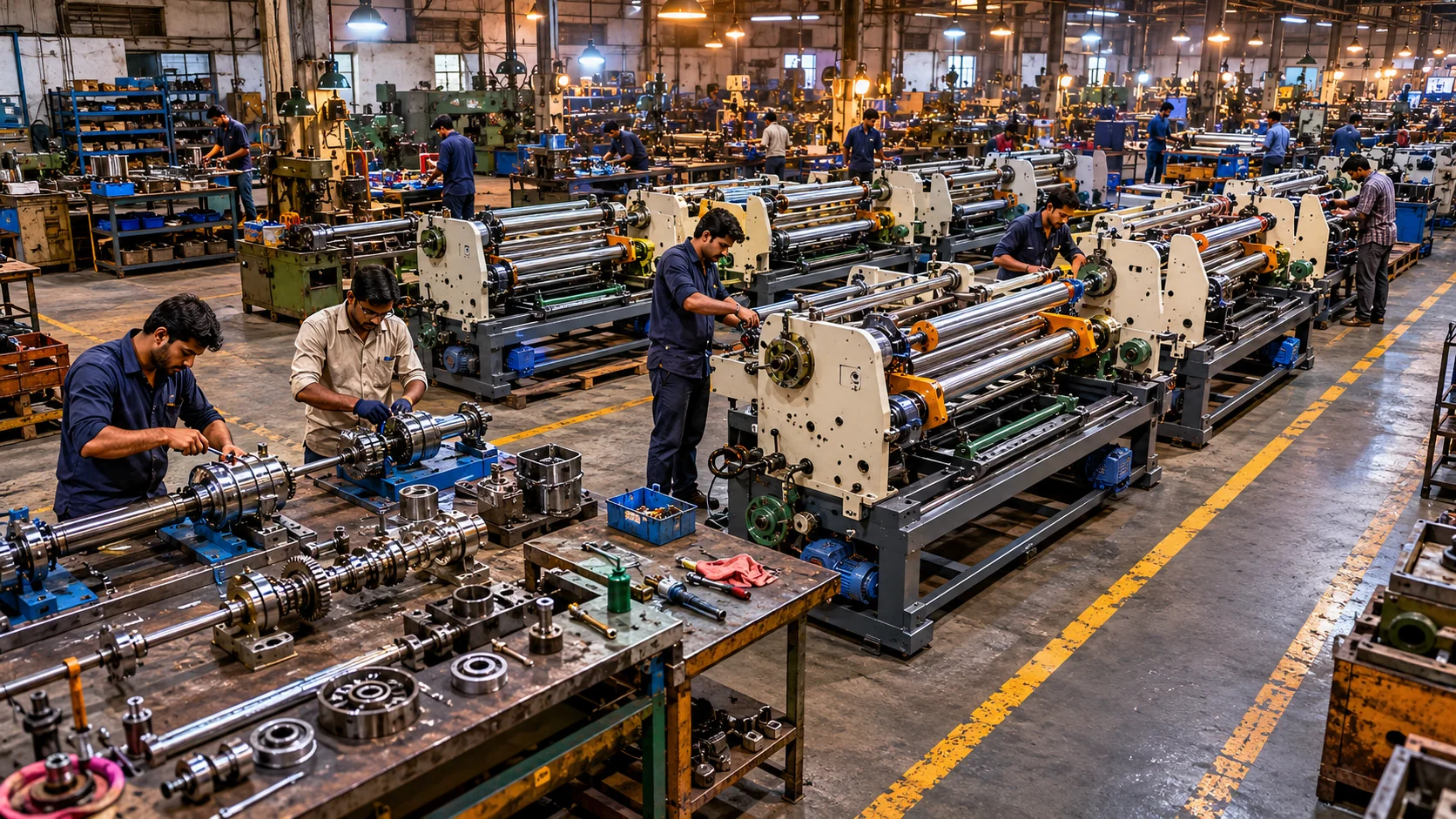
In yarn processing plants across Coimbatore, Surat, Ludhiana, and Ichalkaranji, the same question is surfacing in quality audits and buyer inspections: Where are the knots coming from, and what is it costing us?
For decades, the mechanical knotter was the default answer to a broken or exhausted yarn end on a winding machine. It was cheap, reliable, and familiar. But as Indian mills move into export-quality fabric production — and as loom speeds increase — the knot is showing its limits. A growing number of production managers are making the switch to pneumatic yarn splicers, not as a quality upgrade, but as a production efficiency decision.
What the Knot Actually Does to Your Yarn
A mechanical knot is not just a cosmetic problem. When two yarn ends are tied together, the resulting joint is typically three to six times the diameter of the parent yarn, and it is a genuine weak point — the knot itself can hold as little as 50% of the yarn's original tensile strength under dynamic loading conditions.
That matters at the winding stage. But it matters more at every stage downstream. In weaving, the knotted joint has to pass through the reed, the heddle, and the shed at high speed. In knitting, it passes through a needle eye. On a warping machine, it goes through dozens of yarn guides under tension. At each point, the knot is a potential stop event — and in high-speed operations, a single stop can cost more in restart time and operator attention than the original yarn break that caused it.
The physics are straightforward: a smaller, stronger joint creates fewer problems. That is what splicing delivers.
How Pneumatic Splicing Works
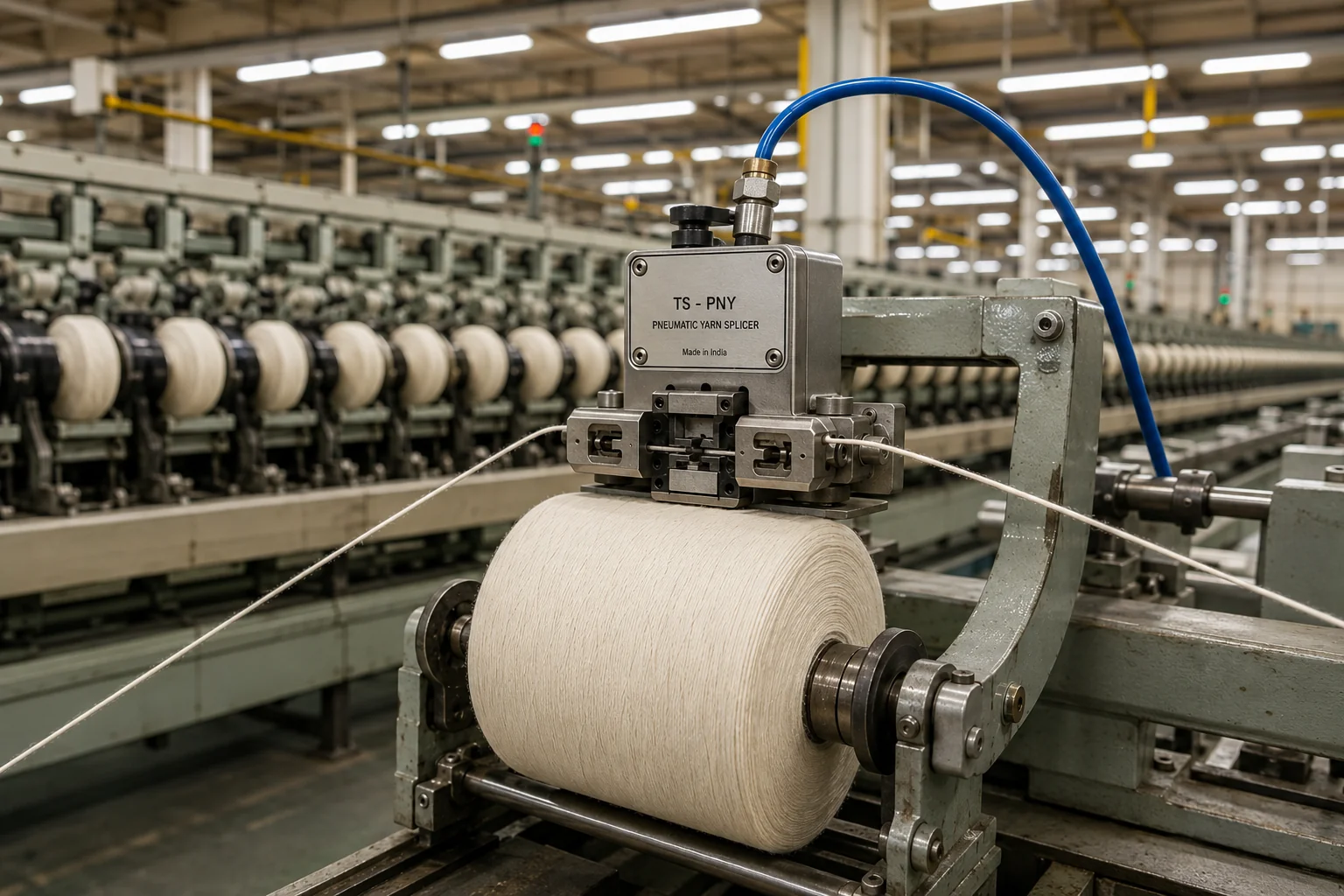
A pneumatic splicer joins two yarn ends using a controlled burst of compressed air inside a splicing chamber. The process has three stages: the yarn ends are prepared (untwisted and trimmed to the correct length), positioned in the chamber, and then subjected to a precisely timed air blast that intertwines the fibres.
The result is a join where the fibres of both yarn ends are physically interlocked — not wrapped around each other like a knot, but woven together. The splice diameter is approximately 1.5 times the parent yarn diameter. Strength retention is 70 to 90% of the original yarn, depending on the count, fibre type, and splicer settings.
The practical consequence: spliced packages pass through downstream machinery with significantly fewer stops, and the joins that do pass through are far less visible in the finished fabric.
The Impact on Loom Efficiency
Modern rapier looms run at 300–500 picks per minute. Airjet looms run faster. At these speeds, a bulky knot passing through the reed or weft insertion system does not slow down gracefully — it causes a hard stop. Depending on the loom type and the knot size relative to the yarn count, the rate of knot-related stops can be significant.
Mills that have switched from knotted to spliced yarn supply packages consistently report a measurable reduction in weft stops. The exact figure varies by yarn count, loom type, and the quality of the previous knotting — but the direction is consistent: fewer stops per shift, more metres woven per shift, lower per-metre fabric cost.
For weaving mills buying yarn from processors, the quality of the join is increasingly specified in purchase orders. Export fabric buyers in particular — supplying garment manufacturers in Bangladesh, Sri Lanka, and Southeast Asia — are specifying "spliced yarn" as a baseline requirement in a growing number of contracts.
Retrofit Splicing on Your Existing Machines
RJK Hand Splicers mount on winding machines, TFO, and warping machines without structural modification. Available for ply yarn and filament yarn.
View Hand Splicer Specifications →Cotton and Blended Yarn: What Changes at the Winding Stage
For cotton ring spun and blended yarn processors, splicing is most directly beneficial at the winding stage — either on cone winding machines or assembly winders preparing packages for two-for-one twisters (TFO).
The RJK Hand Splicer for Ply Yarn covers cotton and cotton blends from Ne 100s to Ne 10s in both single and two-ply configurations, as well as cotton open-end yarn up to resultant Ne 5s. Synthetic and acrylic blends are also within scope. The splicer mounts on the winding machine via an Air Tracking System, allowing a single unit to service any spindle position along the machine.
For TFO operations specifically, knot-related stops are a known production constraint. The TFO spindle is sensitive to tension spikes and joint size. Mills running TFO machines that have switched to spliced supply packages report a measurable reduction in spindle stoppages — particularly on fine counts where the knot-to-yarn diameter ratio is most pronounced.
Filament Yarn: A Different Problem, the Same Logic
Filament yarn — polyester, viscose, POY, LOY — presents a distinct splicing challenge. Unlike staple fibres, filament yarn cannot be untwisted and retwisted by an air blast in the same way. The splicer must join continuous filaments without breaking individual strands.
Filament-specific splicers use specially finished yarn contact surfaces and frictioners that allow parallel filaments to be interleaved without damage. The RJK Hand Splicer for Filament Yarn covers polyester and viscose filament in the 70D to 1500D count range, including POY and LOY.
In filament weaving and knitting applications, the visual impact of the join is particularly important. Knots in filament yarn are highly visible in finished fabric — especially in solid-colour woven or knitted constructions. Spliced joins, being closer to the yarn diameter and uniform in appearance, are far less likely to appear as a defect in the finished cloth.
The Compressed Air Requirement
Pneumatic splicing requires a consistent supply of dry, oil-free compressed air at 6 to 7 kg/cm². Most Indian yarn processing facilities with winding or TFO operations already have a compressed air line on the floor.
The critical variable is air quality. Wet or oil-contaminated air is the most common cause of poor splice quality — weak splices, inconsistent results, or splices that are too thick. Installing a moisture separator and filter on the supply line before the splicer resolves most air-quality-related issues. Air consumption per splice cycle is approximately one litre — the load on the compressor is modest.
For facilities evaluating a retrofit, the compressed air supply should be verified and serviced before commissioning the splicer. RJK's engineering team can advise on air supply requirements during the enquiry process.
Retrofit vs. New Machine: What Makes Sense
The RJK Hand Splicer is designed for retrofitting — it mounts on existing machines using an Air Tracking System or a four-wheel trolley, depending on the application. No structural modification to the winding machine, TFO, or warping machine is required.
This means the decision to switch from knotting to splicing does not require a capital investment in new winding machinery. Mills with serviceable older winding machines can add splicing capability at a fraction of the cost of machine replacement — and realise the downstream benefits (fewer loom stops, better fabric appearance, export compliance) from existing equipment.
For mills that are also evaluating machine replacement, RJK cone winding machines and parallel winders can be configured with integrated splicers from the outset. The full RJK product range covers both retrofit and new-machine paths.
Knot vs. Splice: A Practical Comparison
| Factor | Mechanical Knot | Pneumatic Splice |
|---|---|---|
| Joint diameter | 3–6× yarn diameter | ~1.5× yarn diameter |
| Joint strength | ~50% of parent yarn | 70–90% of parent yarn |
| Visibility in fabric | High — especially in fine or solid fabrics | Low — near-invisible in most constructions |
| Loom stops per 1,000 picks | Higher — knots jam reed and heddles | Lower — joints pass through cleanly |
| TFO spindle stops | Frequent on fine counts | Reduced significantly |
| Export buyer acceptance | Increasingly rejected on fine/export specifications | Accepted as standard |
| Retrofit cost | No additional cost | Splicer unit + compressed air line |
Frequently Asked Questions
What is the difference between yarn splicing and knotting?
Knotting ties two yarn ends together with a mechanical loop, producing a joint that is several times the yarn diameter and weaker than the parent yarn. Splicing uses compressed air to intertwine the fibres of both ends inside a chamber, producing a joint approximately 1.5× the yarn diameter that retains 70–90% of original yarn strength. The splice is smoother, stronger, and far less visible in finished fabric.
Does yarn splicing work for filament yarn like polyester and viscose?
Yes. Filament yarn splicers are designed specifically for polyester, viscose, POY, and LOY in the 70D to 1500D count range. They use specially finished contact surfaces and frictioners to join parallel filaments cleanly without damaging individual filament strands. The RJK Hand Splicer for Filament Yarn covers this application directly.
How does a knot affect loom efficiency?
A bulky knot passing through a reed, heddle, or weft insertion system at loom speed creates a tension spike that can break the yarn or jam the mechanism — stopping the loom. High-speed rapier and airjet looms are especially sensitive to joint size. Spliced joins, being smaller and stronger, pass through at significantly higher rates without causing stops, directly increasing metres woven per shift.
Can a yarn splicer be retrofitted onto an existing winding machine?
Yes. RJK Hand Splicers are designed to retrofit onto existing cone winding machines, assembly winders, TFO machines, and warping machines without any structural modification. The Air Tracking System (ATS) allows the splicer to be repositioned to any spindle along the machine, and a four-wheel trolley version is available for TFO and free-standing applications.
What air supply does a yarn splicer need?
Both ply yarn and filament yarn splicers require dry, oil-free compressed air at 6–7 kg/cm². A moisture separator and in-line filter on the supply are strongly recommended. Wet or oily air is the most common cause of inconsistent splice quality and should be ruled out before adjusting other splicer parameters.
Which yarn counts can RJK Hand Splicers handle?
The RJK Hand Splicer for Ply Yarn covers cotton and blended yarns from Ne 100s to Ne 10s (single and two-ply) and cotton open-end up to resultant Ne 5s. Synthetic, acrylic, and wool blends are also within scope. The Filament Yarn model covers polyester and viscose filament from 70D to 1500D, including POY and LOY. Enquire with your specific count range for confirmation.