When a mill manager in Surat is selecting a new cone winding machine, one of the first questions that comes up is: PLC or mechanical? The answer depends less on which technology is "better" and more on the specific production environment — yarn count range, shift pattern, operator skill level, and service infrastructure.
This guide explains the practical differences between PLC-controlled and mechanical winding machines, covers the scenarios where each type has a clear advantage, and helps production teams make the decision based on operational reality rather than specifications alone.
How PLC Control Works on a Winding Machine
In a mechanical winding machine, process parameters — spindle speed, traverse speed, package taper, and winding ratio — are set through physical components: cams, gears, levers, and timing mechanisms. Changing a parameter means physically adjusting or swapping a mechanical component, which takes time and requires the right spare parts to be on hand.
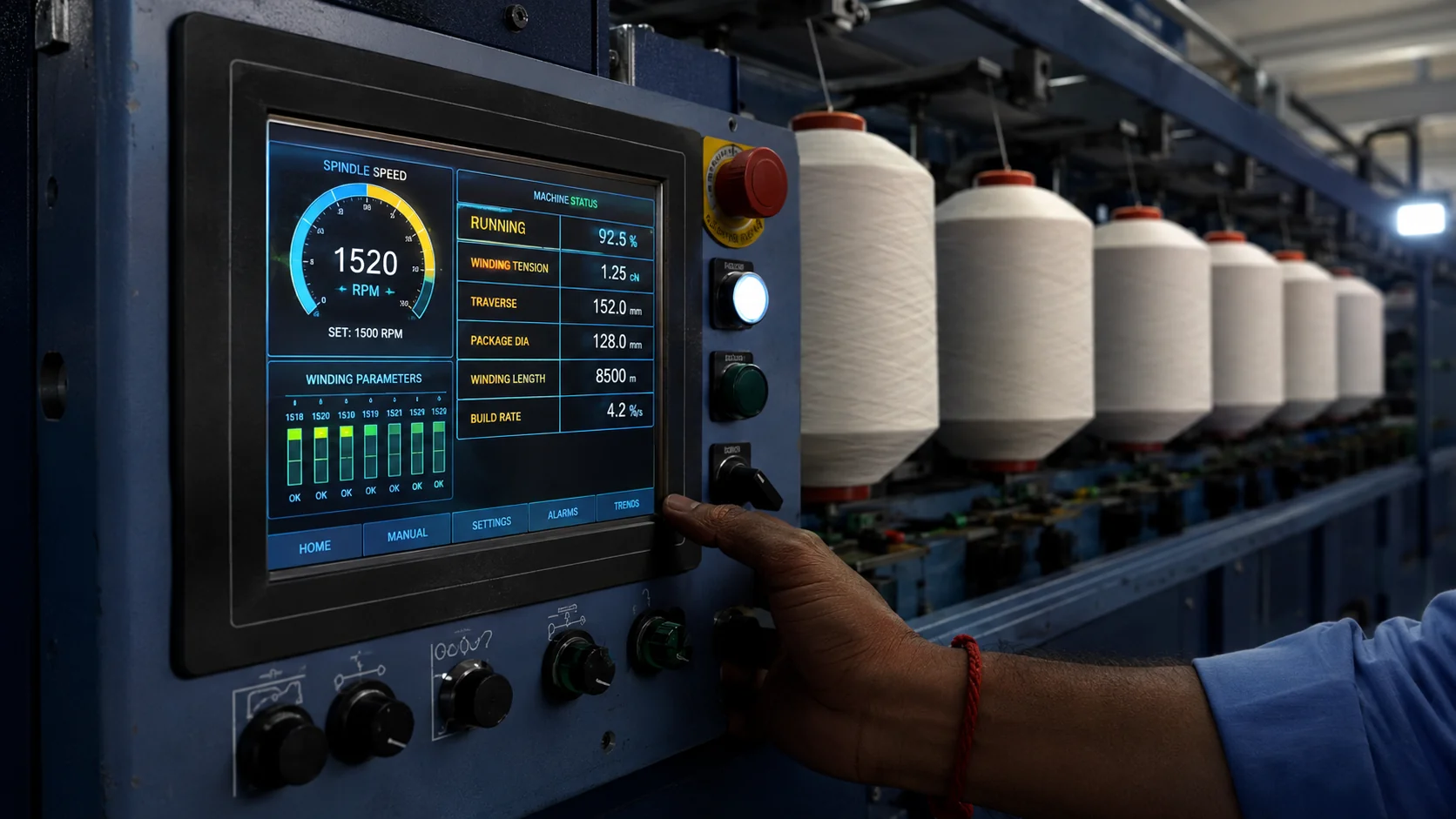
A PLC-controlled winding machine replaces most of these mechanical parameter-setting components with a microcontroller and software. Winding speed, traverse length, package build profile, and tension are entered through a control panel. The PLC translates those inputs into electrical signals that drive servomotors and electronic tensioners.
The result is that changing winding parameters — switching from Ne 20s cotton to Ne 40s polyester, for example — takes minutes at a keyboard rather than hours of mechanical adjustment.
Where PLC Control Has a Clear Advantage
Multi-count or multi-product production
If your mill winds more than one yarn count or switches between yarn types during the week, PLC control pays for itself in changeover time. Recipe profiles for each yarn type can be stored and recalled. An operator can switch the machine from one configuration to another without touching a wrench.
Package quality consistency
Mechanical adjustment introduces operator variability. Two technicians setting the same parameter on a mechanical machine may produce slightly different results. PLC settings are exact and repeatable: if a recipe produced the right package yesterday, it produces the same package today.
Process monitoring and fault detection
PLC machines can be equipped with sensors that detect yarn breaks, tension deviations, and speed anomalies in real time, triggering alarms or automatic stops before a quality problem propagates across the package. Mechanical machines require the operator to detect and respond to these events manually.
Scalability without proportional complexity
Scaling a PLC machine from 24 to 96 spindles does not proportionally increase the control complexity — the same PLC panel manages the additional spindles through the same interface. Scaling a mechanical machine adds proportionally more mechanical components to set, adjust, and maintain.
Where Mechanical Winding Machines Still Make Sense
Single-count, stable production
If your mill runs the same yarn count on the same machine year-round — a common scenario in dedicated spinning units — the flexibility advantage of PLC control is never used. A well-maintained mechanical machine in this environment will produce the same output at lower capital cost.
Limited electronics service infrastructure
PLC components require electronics-capable service technicians. In areas where this expertise is not locally available, a mechanical failure can be diagnosed and repaired by any competent machine fitter. A PLC fault requires either a trained electronics technician or a call to the manufacturer's service team. For mills in secondary locations, this is a genuine operational consideration.
Capital cost constraints
PLC machines carry a price premium over their mechanical equivalents. For a mill where capital is constrained and the production profile does not demand PLC flexibility, a mechanical machine may be the financially correct choice — particularly if the difference in capital cost can be redeployed elsewhere in the production line.
Not Sure Which Configuration Suits Your Mill?
Share your yarn count range, shift pattern, and spindle requirement — our team can recommend the right machine type and configuration for your specific setup.
Get a RecommendationThe RJK Primo: PLC Control at Indian Pricing
The RJK Primo Winding Machine is RJK Group's PLC-controlled cone winder, available in 8 to 96 spindle configurations. It is designed for mills that need the flexibility and consistency of electronic control without the capital outlay of European imported machinery.
The Primo's PLC panel stores multiple winding recipes, controls spindle speed and traverse parameters electronically, and supports both cotton and synthetic yarn applications. Service and spare parts are available from Ahmedabad, with overnight delivery across India.
A Decision Framework
The choice between PLC and mechanical winding machines comes down to four questions:
- How often do you change yarn count or type on this machine? — Frequently: PLC. Rarely or never: mechanical may suffice.
- How critical is package-to-package consistency? — High-consistency requirement: PLC. Standard production: either type is suitable.
- What is your service infrastructure like? — Good electronics service locally: PLC is low-risk. Limited electronics expertise nearby: mechanical reduces service risk.
- What is your capital budget? — If the PLC premium is justified by the above answers, pay it. If not, the mechanical machine does the job.
There is no universally correct answer. The right machine is the one that matches your production reality — not the one with the most features on paper.
Frequently Asked Questions
What is a PLC-controlled winding machine?
A PLC winding machine uses an electronic controller to manage winding parameters through software settings rather than mechanical components. Parameters like spindle speed, traverse, and tension are set via a control panel and stored as recipes, allowing fast changeover between yarn types.
Is a PLC winding machine more expensive to maintain than a mechanical one?
PLC machines have fewer mechanical wear parts for parameter control but introduce electronic components requiring a different service skill set. In areas with good electronics service, PLC maintenance costs can be lower. In remote locations, mechanical machines may be easier to keep running.
How many spindles can a PLC winding machine handle?
PLC machines are scalable. The RJK Primo is available from 8 to 96 spindles, all managed through a single control panel. Scaling adds spindles without proportionally increasing control complexity.
Can a PLC winding machine handle multiple yarn types?
Yes — stored recipe profiles for different yarn counts and types can be recalled in minutes. Switching between yarn types requires no mechanical adjustment, reducing changeover time and operator error.
Which mills should choose a mechanical winding machine over PLC?
Mills with stable single-count production, limited local electronics service, or capital constraints where PLC flexibility is not required. Mechanical machines are also suitable as secondary or auxiliary machines in larger mills.